

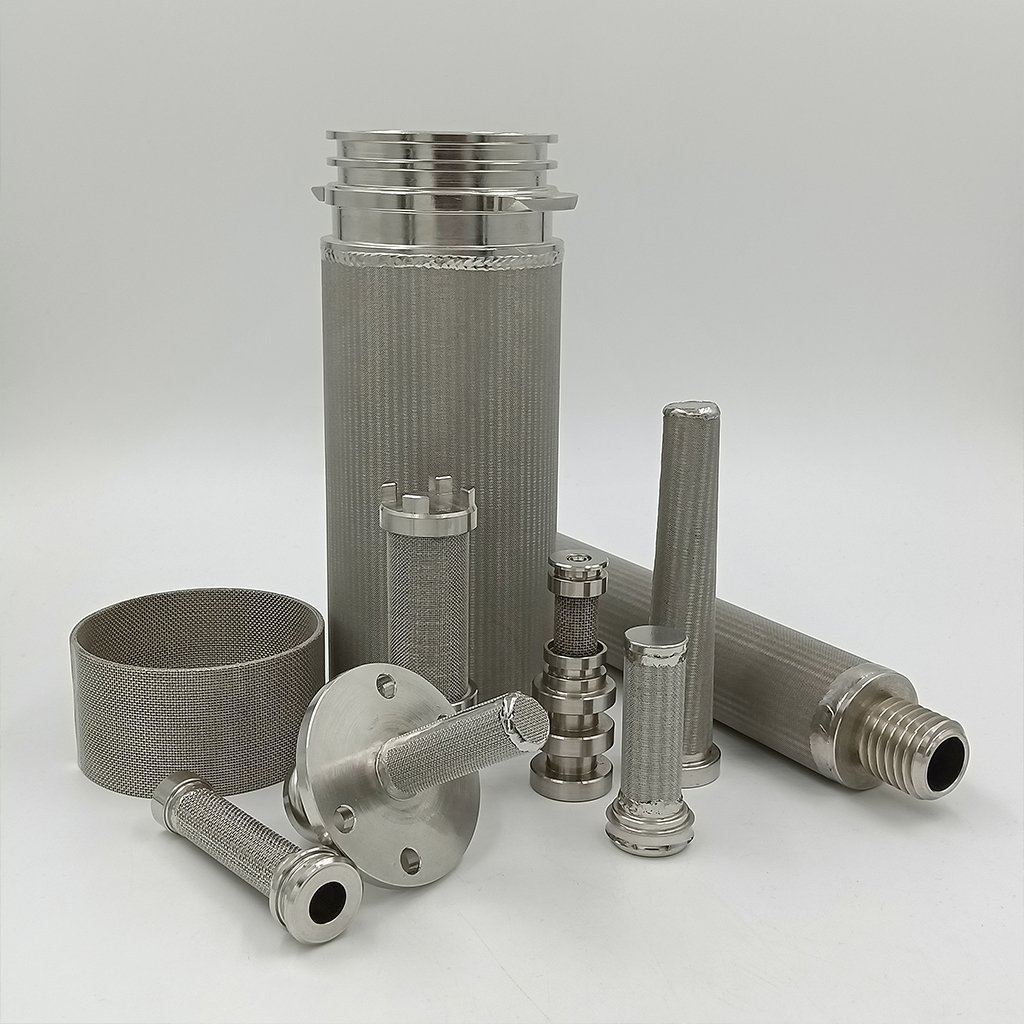
Woven mesh is familiar, light and economical, but it has limits. Under high pressure, high temperature or repeated cleaning, mesh can flex, shift or wear, and its filtration performance can change. Sintered metal filters were developed for exactly those harder duties, where a stable, rigid porous structure matters more than the lowest initial price.
This article explains how sintered filters are made, what gives them their strength, and how to decide when they are a better choice than conventional mesh.
What “Sintered” Actually Means
Sintering is a high-temperature process in which metal powders, fibres or mesh layers are heated so the particles bond together at their contact points, without fully melting into a solid sheet. The result is a porous metal body: strong like metal, but with a controlled network of pores that fluid or gas can pass through.
The resulting structure is rigid and self-supporting, a key difference from unsupported woven mesh.
The Main Forms of Sintered Filter Products
- Sintered metal powder filters — made from compacted metal powder, with a uniform porous body suited to precise filtration and flow control
- Sintered stainless mesh filters — mesh layers bonded together for strength and stable pore size
- Sintered wire mesh laminates — multiple mesh layers with different functions, such as filtration, support and protection, sintered into one plate or element
These forms can be made into discs, tubes, cartridges, cones and custom shapes.
Materials and Temperature Capability
Material choice should start with corrosion, temperature and fluid compatibility. Common options include stainless steel 304, 304L, 316 and 316L, Hastelloy, Monel, Inconel, Titanium, Copper and Bronze. Stainless grades are the workhorse for many applications, while special alloys are selected for more corrosive or hotter processes.
Filtration ratings for sintered products typically cover 0.5-200 μm. For temperature, stainless grades can be used up to 600°C, with special alloys up to 900°C in suitable conditions. Always confirm the full operating picture — temperature, pressure, chemistry and cleaning method together — rather than selecting on temperature alone.
Where Sintered Filters Outperform Mesh
Pressure and mechanical shock. A sintered body has high burst and collapse resistance and does not rely on a separate support in the same way a thin mesh does. It tolerates pressure pulses and back-flushing better in many designs.
Heat and harsh chemistry. Polymer media and many mesh assemblies cannot operate where sintered metal can. In hot gas, steam, aggressive liquids and solvent service, a correctly chosen metal grade keeps its structure.
Stable performance over time. Because the layers or particles are bonded, the pore structure does not shift under flow in the way an unsupported mesh can. That stability helps maintain a more consistent pressure drop and filtration result.
Cleaning and reuse. Sintered elements can often be cleaned and returned to service by backwashing, ultrasonic cleaning or chemical cleaning, depending on the contaminant and material. Over a long service life, reuse can offset a higher purchase price — provided cleaning is planned and the element is inspected after each cycle.
Where Mesh May Still Be the Better Choice
Sintered is not always the answer. For low-pressure, low-temperature duties with light contamination, a simple mesh or a disposable element may be cheaper and entirely adequate. Sintered elements also need a sensible cleaning plan; if a contaminant permanently plugs the pores or reacts with the material, reuse may not be practical.
How to Specify a Sintered Filter
- Fluid or gas, and any corrosive components
- Required filtration rating and acceptable pressure drop
- Operating and maximum temperature and pressure
- Flow rate and direction, including any backwash duty
- Shape, dimensions, connections and sealing method
- Preferred material grade and cleaning method
- Whether a drawing or sample is available
For custom shapes, a drawing removes ambiguity about tolerances, edges and fittings. If no drawing exists, a sample plus the operating conditions is the next best starting point.
FAQ
Can sintered metal filters be cleaned and reused?
Often, yes. Depending on the contaminant, backwashing, ultrasonic cleaning or chemical cleaning can restore flow. Inspect the element after cleaning for damage and check that pressure drop has recovered before returning it to critical service.
Are sintered filters stronger than woven mesh?
Generally, a sintered body is more rigid and self-supporting than a single unsupported mesh, with higher resistance to bursting and collapse. A sintered mesh laminate also keeps its layers bonded, so the structure stays stable under pressure.
Which material should I choose for high temperature?
Start with the temperature, then check corrosion and fluid compatibility. Stainless steel grades suit many duties up to 600°C, while special alloys can be considered for higher temperatures up to 900°C or more aggressive chemistry. Share your full conditions before deciding.
If your application involves heat, pressure or repeated cleaning that is wearing out mesh, explore our sintered filter products to compare powder, mesh and laminate forms, and then contact us through our contact page with your drawing or operating conditions for a material and structure recommendation.